News
Discover-Eat charts a course towards better gastronomic towns and regions with a bright future
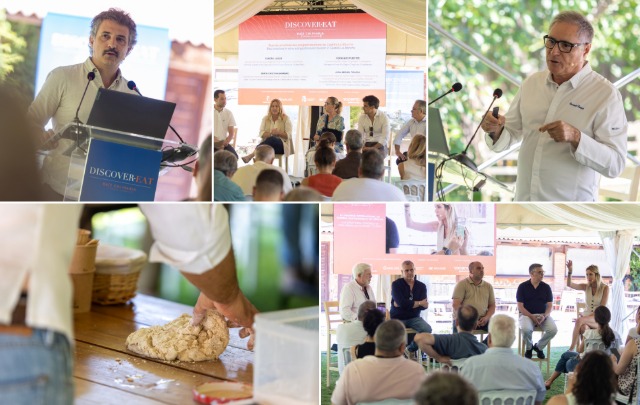
The second edition of the Discover-Eat International Congress on Non-Urban Gastronomic Tourism, organised by Vocento Gastronomía and supported by the Government of Castilla-La Mancha, drew to a close with a call to protect and recognise the gastronomic heritage of rural areas, to offer visitors experiences that connect them to the local area, to develop a new form of agritourism that takes into account artisanal produce and traditional culture, and not to lose sight of hospitality. Drawing on the expertise of tourism specialists such as Lindsey Gallagher, president and CEO of Visit Napa Valley, and Erik Wolf, executive director of the World Food Travel Association, as well as examples of successful projects such as the restoration of the Tabernas do Alto Tâmega (Portugal), this international forum has, over the course of these three days, charted the way forward to ensure that gastronomy continues to act as a driving force for rural tourism. The director of the conference, Benjamín Lana, summed it up at the closing ceremony: “Gastronomy has the power to connect people, and people with their local areas, and it is the catalyst upon which the future of rural life can flourish”.
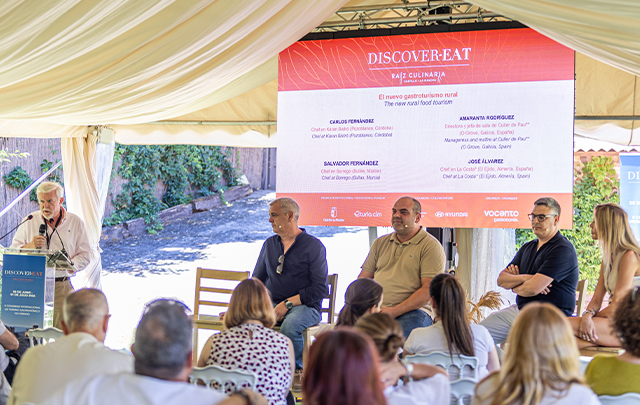
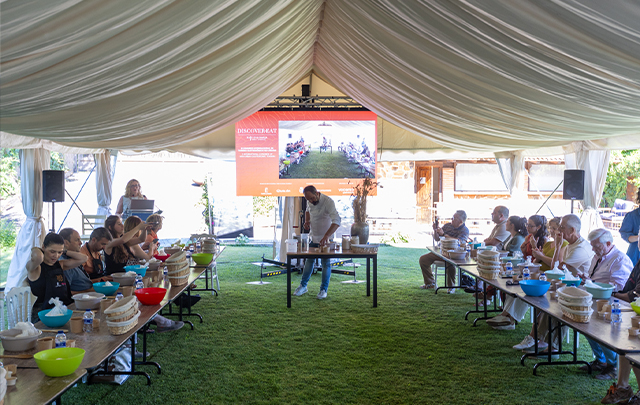
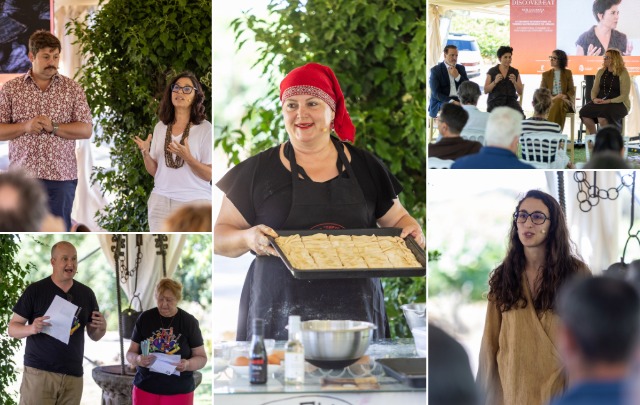
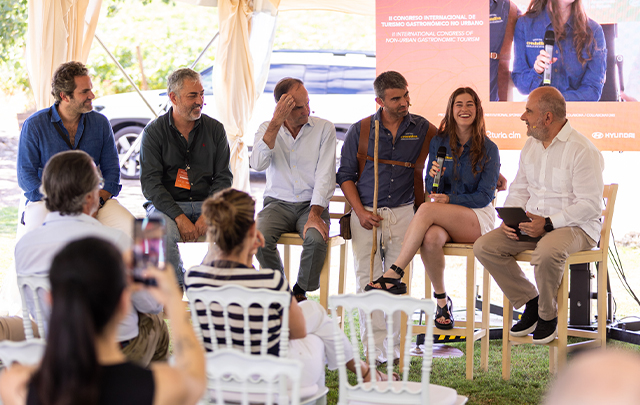
The final day of Discover-Eat took place in a venue that embodies many of the attractions highlighted at this forum as key drivers of rural tourism: an authentic setting, a haute cuisine restaurant with a menu rooted in the local area, a distinctive and experiential range of leisure activities, and a sustainable project… This is the Molino de Alcuneza, a Relais & Châteaux boutique hotel and Michelin-starred restaurant. Indeed, it was the chef at the Molino de Alcuneza*, Samuel Moreno, who kicked off the morning with a workshop on artisan bread-making, at the end of which the conference attendees were able to take home their own loaf. An activity that could well be part of the new paradigm of rural agritourism, a topic discussed at the round-table discussion featuring Carlos Fernández, chef at Kàran Bistró (Pozoblanco, Córdoba); Salvador Fernández, chef at Borrego (Bullas, Murcia); Amaranta Rodríguez, director and maître d’ at Culler de Pau** (O Grove, Galicia, Spain); and José Álvarez, chef at La Costa* (El Ejido, Almería).
With these restaurateurs based in areas off the beaten track of mass tourism, Discover-Eat has tackled the challenges of the new gastronomic tourism. Accommodation is often one such challenge, as these establishments are located in areas with poor transport links or where tourism is highly seasonal. In response, many have opted to offer “good food and a good night’s sleep”, explained Salvador Fernández. This is a path that Culler de Pau has also taken, where the rural apartments are “a natural extension of the restaurant”, said its director. However, as José Álvarez pointed out, the greatest challenge is perhaps “the constant need to reinvent oneself, to seek new ways of attracting customers”.
As the foundation for all this, the participants in this round-table discussion once again agreed on the importance of not losing sight of the local environment, because “if we want to promote the region, we have to work hand in hand with our neighbours, producers and craftspeople”. Finally, the chef from Murcia championed the strength of rural destinations in the face of the uniformity of urban tourism, in which, at present, “cities are mere carbon copies of one another”.
Some of the keys to persuading tourists to choose a non-urban destination might be found in the early days of tourism, in the 18th century, as explained by Felipe Vidales, PhD in History. The professor looked to the past to explain how the diaries of the first travellers – mainly politicians and scientists from the elite – “allow us to rethink modern tourism”. Journeys in those days were long, so “people discovered things as they travelled; there were no set destinations”; we should learn from this and “steer clear of hackneyed destinations and big cities, and discover new territories”. The historian also reflected on the extent to which we should cater to tourists: “in the past, visitors were given what was available, not what they demanded”.
Premium rural tourism
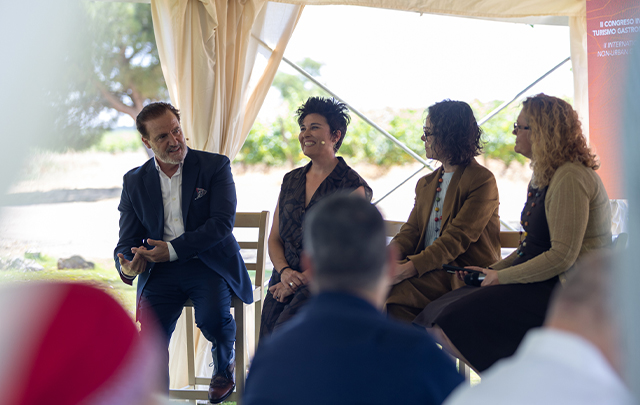
During Discover-Eat, there was repeated discussion of the power of gastronomy to drive change in rural areas, but how can this be achieved? Carmelo Bosque, chef and owner of Lillas Pastia*, offered some advice. He is the culinary representative of the Spanish province of Huesca, which has undergone one of the most recent gastronomic revolutions. Huesca – which will also host the Michelin Guide gala next year – “boasts 8 Michelin stars with a population of just 250,000”; but Carmelo wanted to make it very clear that “the stars are the consequence, not the cause” of this success. Establishing a region, gastronomically speaking, first involves “slowly developing the territory, having a narrative, a high-quality product that defines its identity, and striving for excellence”. Drawing on Huesca’s own experience, the chef at Lillas Pastia also pointed out that it is essential to “retain talent”, offer opportunities and create an ecosystem – a network – because “we are not in competition with one another; we feed off each other, we help one another, and that is how the region moves forward”. Alfredo Lachos, a hospitality consultant and trainer, added to this list of advice by emphasising the importance of hospitality: “The landscape attracts, the cuisine excites, but we mustn’t lose sight of the human factor. It is the people who make visitors want to return.” The people of a region are also its heritage.
The combination of cuisine and wine is a driving force in many rural areas, something which in Castilla-La Mancha – home to the world’s largest vineyard – takes on even greater significance, if that is possible. The role of wine tourism was also discussed on Discover-Eat with Sandra Luque, technical director of the Pago del Vicario Group (Porzuna, Ciudad Real); María Cristina Barrero, director of wine tourism at Bodegas Martúe (Campo de la Guardia, Toledo); Víctor Fuentes, commercial director of Finca Río Negro; and Juan Miguel Tolosa, co-owner of Pagos de Familia Vega Tolosa and president of the Manchuela Wine Route (Casas-Ibáñez, Albacete). Indeed, the fact that it is the largest wine-growing region creates a need for differentiation, something which, according to Sandra Luque, “can be achieved through wine tourism, as it offers a sense of closeness that allows you to explain things”. Víctor Fuentes added that these activities also represent an opportunity to “break down barriers and shake off the snobbery that sometimes exists in the sector”. All the winemakers agreed that wine tourism – like everything in the rural world – does not work on its own: “the more activities an area can offer, the more people will come”. Within their sector, they are providing increasingly immersive activities such as taking part in grape harvests or grape treading.
Related news
News
Gastronomic tourism as a lifeline for the countryside
News
Wine tourism is being reinvented in Castilla-La Mancha: from the cult of wine to enjoyment without snobbery
News

When Spain didn’t know how to market its cuisine or its stars
News

Huesca: a hub for haute cuisine and radical hospitality
News
Bread, that great unknown
News
Rural tourism is also looking to the stars for allies
News
Rural tourism and artisan cheeses: how the Spanish countryside is reinventing itself
News
Astrotourism and dark skies: when the countryside becomes cosmic luxury
News

The winegrower who brought the stars together with the glass: Juan Jesús Valdelana’s wine tourism revolution
News