News
The winegrower who brought the stars together with the glass: Juan Jesús Valdelana’s wine tourism revolution

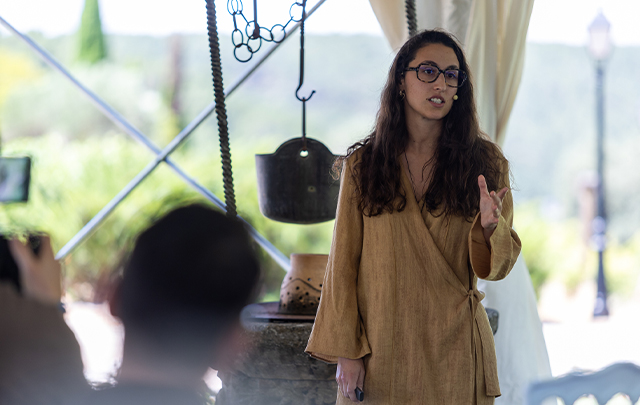
Winegrower Juan Jesús “Juanje” Valdelana, the 13th generation of a family with roots in La Rioja Alavesa, argued in his presentation that, in wine tourism, the product is less important than the human experience. He stated that what visitors value most is how they are welcomed and the warmth of the setting, with the wine coming only in third place; customers “take the quality of the wine for granted” if the other aspects have been successful.
Valdelana wove his narrative from his family’s origins — an ancestor, Pedro Ibarrola, a coal miner who changed his surname to Valdelana when he settled as the area’s first winegrower — right through to his own training at the monastery of San Millán de la Cogolla, the cradle of the Castilian language. He pointed out that Rioja attracts mainly gastronomic tourism and very little cultural tourism, despite the historical significance of sites such as San Millán.
He recalled the depopulation of the countryside in La Rioja Alavesa and how the Basque Government responded by training one young person from each village in viticulture, oenology and marketing, which has made wine the leading agri-food sector in the Basque Country. He highlighted that 9,800 people make their living directly from wine in the region and that around 4,000 rely on it as their main source of income, with 330 million bottles bearing the name of their land.
As for wine, he summarised his philosophy in four pillars: the land, the climate, the grape variety and human intervention as a mere conduit between nature and the final product. He emphasised that a bottle encapsulates everything that has happened in a region over the course of a year, even though 99 per cent of its composition is similar across all bottles; “only 1 per cent makes it different”, he remarked, drawing a comparison with a tear and its emotional content.
Valdelana explained how he fused his knowledge of oenology with catasterism — the Greco-Roman mythology projected onto the firmament, which he studied for six years — to link wine and the stars. From this vision came Centum Vitis, a wine made from pre-phylloxera vines with a high resveratrol content, to which he adds edible gold petals sourced from Nuremberg. As he explained, the product is positioned as a unique project, even used to celebrate the end of Ramadan at United Arab Emirates embassies in cities such as Paris, London and New York.
The winemaker has acquired estates where the remains of a Neolithic dolmen, a Visigothic settlement, a necropolis and a Roman settlement are situated, creating a journey through the civilisations that have inhabited the southern face of the Sierra Cantabria since the Jurassic period. During his tours, he avoids technical explanations about barrels and vats, focusing instead on creating a unique experience that turns the visitor into a ‘disciple’ of the brand.
Valdelana boasted that his winery is the most highly awarded in competitions representing Rioja and Spain, with four awards, ahead of historic names such as Marqués de Riscal, Marqués de Murrieta and Muga. One of its jewels is the Romanera estate, situated on a bend in the River Ebro, as far as Emperor Tiberius travelled; he planted Vitis vinifera there to supply wine to the Roman legions. Today, it still boasts pre-phylloxera vineyards of the very highest quality.
Its flagship wine tourism offering is the ‘stellar pairings’, organised at a five-hectare experimental vineyard featuring 135 grape varieties from around the world, planted in rows, each representing a different country. This research vineyard aims to determine which varieties offer the greatest aroma, colour, acidity or stability, and also serves as the setting for an event combining dinner, music and astronomy.
In July and August, they welcome 150 people there every weekend. They serve seven locally sourced tapas prepared on site, accompanied by a concert. Once dinner is over, with no light pollution, a laser guided by a two-hour programme locates stars in the night sky, ‘brings’ them onto a three-metre screen and pauses to explain their history. Each star is paired with a wine and a song, weaving a narrative that links the night sky, the glass of wine and the soundtrack.
These stellar pairings have spread from La Rioja Alavesa to the wider world, with performances in places as diverse as Lake Baikal in Siberia, Germany, the Netherlands, Belgium, Mexico, Guatemala and the Canary Islands. They are used both to support distributors and importers in promoting wines and for exclusive private events.
Valdelana concluded his talk with a fable by Samaniego about an old man who implores Death to let him continue living “in good company and with a glass of fine wine by his side”. With this image, he emphasised time as the most valuable asset – something that cannot be bought or recovered – and linked this reflection to the responsibility of those working in wine tourism: to ensure that the time visitors entrust to them becomes an experience capable, in his words, of “kissing the soul, because anyone can kiss the skin”.
Related news
News
Discover-Eat charts a course towards better gastronomic towns and regions with a bright future
News
Gastronomic tourism as a lifeline for the countryside
News
Wine tourism is being reinvented in Castilla-La Mancha: from the cult of wine to enjoyment without snobbery
News

When Spain didn’t know how to market its cuisine or its stars
News

Huesca: a hub for haute cuisine and radical hospitality
News
Bread, that great unknown
News
Rural tourism is also looking to the stars for allies
News
Rural tourism and artisan cheeses: how the Spanish countryside is reinventing itself
News
Astrotourism and dark skies: when the countryside becomes cosmic luxury
News