
News
At Discover-Eat, leading international figures champion gastronomic heritage as a strategic driver of rural tourism
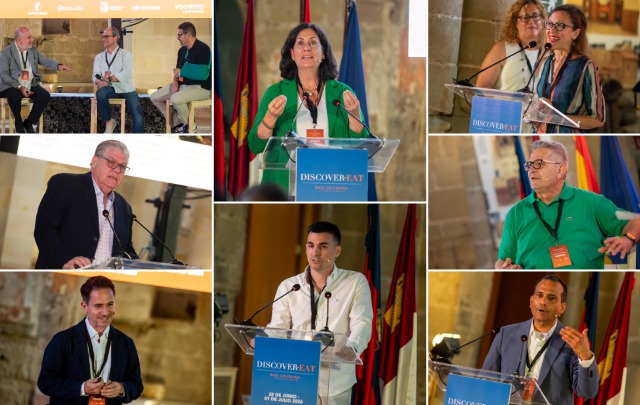
Showcasing local heritage, authenticity and sustainability were key themes on the first day of the second edition of Discover-Eat, an international forum focusing on non-urban gastronomic tourism, which is being held in Castilla-La Mancha until next Wednesday, 1 July. With tourism experts such as international consultants Erik Wolf, Lindsey Gallagher and Hubert Gonera, who have shared ideas on optimising resources in rural tourist destinations, as well as the participation of chefs Enrique Pérez and Vicent Guimerà and the Italian artisan ice-cream maker Franco di Iorgi, who have highlighted the value of authenticity in their offerings, Discover -Eat is cementing its position as a forum for debate on new trends in rural gastronomic tourism.
Organised by Vocento Gastronomía and promoted by the Government of Castilla-La Mancha, Discover-Eat’s main objective is “to give a boost to rural development through tourism and gastronomy”, as Arantxa Pérez Gil, Director-General of Tourism, Trade and Crafts for the Regional Government of Castilla-La Mancha, stated during the conference’s opening ceremony. This was a point emphasised by the Director-General of Vocento Gastronomía, Benjamín Lana, who added that “it is not just about attracting tourists but also about creating good places to live”. Areas such as Sigüenza and its surrounding villages – which will host this conference in 2026 – and for which, in the words of its mayor María Jesús Merino, “it is very important to host initiatives such as Discover-Eat because of the visibility it brings us”. For her part, Patricia Franco, the Regional Minister for the Economy, Business and Employment of Castilla-La Mancha, emphasised the efforts of the region’s gastronomic sector, “without which this conference and all the benefits it will bring would not be happening”.
Against the unrivalled backdrop of the Church of Santiago in Sigüenza, Discover-Eat kicked off the morning session with a reflection by Erik Wolf, Executive Director of the World Food Travel Association, on the importance of gastronomic tourism as a driving force for making a region a more liveable place. “Visitors need reasons to come, and residents need reasons to stay,” Wolf summarised. To this end, the tourism consultant emphasised the need “to showcase our own heritage”, a first step that sets in motion a process involving “the recognition of heritage, pride – which leads to caring for it and promoting it – and collaboration between various stakeholders, which entails working together and creating new opportunities, thereby achieving liveability and building places where people can live”. In this regard, Erik Wolf asserted that Spain “has the heritage (gastronomically speaking) but is suffering from a crisis of recognition” which keeps it hidden from view, “and potential visitors cannot seek out what they do not know exists”, he concluded.
He criticised the fact that the international image of Spanish gastronomy is reduced to clichés — paella, sangria, tapas — whilst an immense wealth of cured meats, cheeses, stews, wines and agricultural produce of the very highest quality remains hidden.
Such visibility is sometimes even necessary at a national level, as explained by Rubén Pérez, director of operations at Rusticae, a consultancy specialising in charming accommodation in rural settings. Pérez also provided another interesting statistic regarding the future of non-urban areas: “of the overall tourist occupancy figures, only 40 per cent corresponds to rural areas, meaning there is plenty of scope for further growth”. This is a window of opportunity that rural destinations must capitalise on to offer “less overcrowded tourism, more closely tied to the local area and focused on the quality of the experience”.
Creating that tourism brand that makes people choose you as a destination is essential in this process – a point raised by Lindsey Gallagher, president and CEO of Visit Napa Valley, a destination marketing organisation working to maintain this Californian valley’s status as the state’s leading tourist destination. Gallagher agreed with Erik Wolf on the importance of conserving and promoting heritage – an example of this being “the protection of the valley’s 94,000 hectares of vineyards, our main tourist attraction” – but she also emphasised the need to work towards “maximising the economic impact of these visitors”. In this regard, the CEO of Visit Napa Valley explained that it is essential to create attractive initiatives to “strike a balance between residents and visitors: by spreading tourism across the year to minimise its impact on the community, or by dispersing it geographically so that the valley’s five towns all benefit from the flow of tourists”. As a gastronomic example of these initiatives, she mentioned ‘Restaurant Month’, featuring activities in restaurants during a quiet month such as January.
Another example of optimising wine tourism was provided by Hubert Gonera, CEO of Landbrand and driving force behind Poland’s National Gastronomic Tourism Plan. Gonera asserted that the future of tourism lies in combining the gastronomic factor with sustainability and the regenerative power of tourism itself. Based on the premise that “being part of the community that welcomes us and connecting with it makes us feel better”, Hubert Gonera asserts that experiential tourism—which allows us to “leave the place we visit in a better state than we found it”—is an avenue worth exploring at a time when visitors are seeking new ways to engage with local areas. In his native Poland, Gonera has launched a project with four wineries that allows visitors to become involved in their day-to-day work from various perspectives and depending on the time of year: “the guest works side by side with the winery owner, learns about the process, takes part in it and also provides feedback on the activity”. An experience that goes beyond mere immersion, “it allows you to step into someone else’s shoes and discover the place in a unique way”.
Discovering the flavour of each place
It is precisely this uniqueness—what sets one place apart from another—that is another of the main reasons for choosing a destination. This is an area where gastronomy has a great deal to offer. Proof of this can be found in the culinary offerings that Enrique Pérez (El Doncel*) and Vicent Guimerà (Antic Molí*), based in Sigüenza (Guadalajara) and Ulldecona (Tarragona) respectively, present to their guests. “Cooking is about expressing how you feel about your land, how you relate to it and to its producers,” explained the chef from Castile-La Mancha. For Enrique Pérez, it is essential to get to know a place by savouring it: “coming to eat green chickpeas when they are in season and understanding that this is how it has to be”. Guimerà agreed with him, adding that “a restaurant’s cuisine is enriched by its surroundings”; something essential for Vicent, who lives in the Ebro Delta, an area where the cultures of the people of Catalonia, the Valencian Community and Aragon intersect. The chefs also took the opportunity to call for greater consideration from the authorities because “to eat the land, that land must exist; it must not be made to disappear under protection measures and legislation that sometimes make no sense and deprive us of many products. There would be greater culinary diversity if we listened to the land”, they warned.
And just as there’s nowhere better than Sigüenza to eat green chickpeas, or the Ebro Delta to enjoy mantis shrimp, if you want to try the Tartufo, you’ll have to go to Pizzo Calabro. Franco di Iorgi, a second-generation member of the Calabrian ice-cream parlour Ercole and the creator of the Tartufo, stated in Discover-Eat that “the way to offer something authentic and of high quality is to maintain its artisanal production”. A statement of intent from a master ice-cream maker who has refused to industrialise the production of this ice cream, which has become a veritable emblem of the coastal town of Pizzo Calabro and has been the driving force behind the year-on-year increase in visitor numbers.
Orazio Belletini (director of the Fuegos Foundation, Ecuador) brought the first day of Discover-Eat to a close by explaining the experience of the Ecuadorian province of Manabí in becoming a World Gastronomy Region. Manabí is a “region rich in biodiversity and culture, but this has not translated into well-being for its people”, Belletini reminded the audience, whilst pointing out that all the products for which Ecuador is internationally renowned come from that region: cocoa, tuna, prawns… It is precisely this gastronomic wealth, as well as its historical and cultural legacy, that has enabled Manabí to become a World Gastronomy Region in 2026. With a culinary identity in which women are the guardians of tradition, preserving the culinary heritage, and in which age-old techniques and produce have been preserved, Manabí is now investing in education and training for the future, precisely to enhance the gastronomic value of this rich larder through innovation. This project exemplifies the transformative power of gastronomy in a region undergoing social and tourism-led regeneration.
Related news
News
Discover-Eat charts a course towards better gastronomic towns and regions with a bright future
News
Gastronomic tourism as a lifeline for the countryside
News
Wine tourism is being reinvented in Castilla-La Mancha: from the cult of wine to enjoyment without snobbery
News

When Spain didn’t know how to market its cuisine or its stars
News

Huesca: a hub for haute cuisine and radical hospitality
News
Bread, that great unknown
News
Rural tourism is also looking to the stars for allies
News
Rural tourism and artisan cheeses: how the Spanish countryside is reinventing itself
News
Astrotourism and dark skies: when the countryside becomes cosmic luxury
News