
News
Franco Di Iorgi: the guardian of the Tartufo di Pizzo
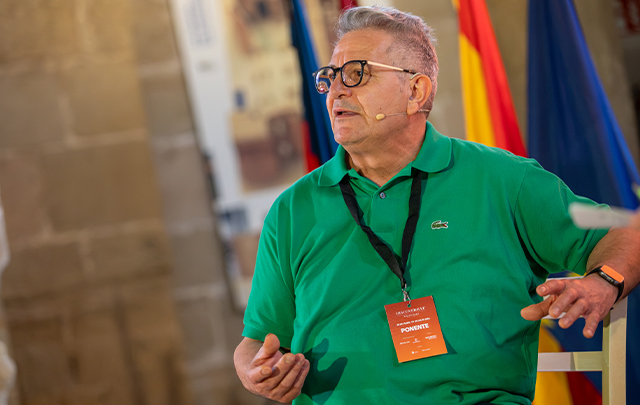
In his speech, master ice-cream maker Franco Di Lorgi outlined the history and current status of the famous Tartufo di Pizzo Calabro, which has now become one of the main tourist attractions in this small coastal village in Calabria. He recalled that the ice cream was first created in 1952 to mark a high-society wedding held at the local castle, when a master ice-cream maker — of whom his father was a pupil — devised a single-portion, hand-moulded ice cream in the shape of a truffle, hence its name.
Di Lorgi explained the production process, which remains faithful to the original method: three fundamental stages – pasteurisation of milk, eggs and sugar; churning; and the creation of the cream – and a recipe based on top-quality ingredients: milk, eggs, sugar, hazelnuts, cocoa and a dark chocolate centre that remains creamy even at very low temperatures. He emphasised that, although the industry now streamlines many steps, he continues to make it “just as my father did”.
The ice-cream maker recounted how the Tartufo spent decades as a virtually unknown product outside the local area until, in the 1970s, the media began to take an interest in it, catapulting it first to the Italian public and then to an international audience. Today, at the height of the summer season, his small family-run ice-cream parlour can sell up to 2,000 Tartufos a day, with a predominantly foreign clientele for whom tasting this ice cream has become “a must-do”, as essential as seeing the Pope when visiting Rome.
Despite this success, Di Lorgi has consistently rejected industrial-scale production and distribution to third parties. He maintains that, to remain authentic and artisanal, the Tartufo cannot be produced in large quantities. “If it’s done solely for money, it’s better not to do it at all,” he warned, emphasising that love and passion are the driving forces behind artisanal work, which is often undervalued. Finally, he expressed confidence in the next generation—two of his four children are already following in his footsteps—and emphasised the importance of working with local and organic produce as the foundation of high-quality cuisine.
Related news
News
Discover-Eat charts a course towards better gastronomic towns and regions with a bright future
News
Gastronomic tourism as a lifeline for the countryside
News
Wine tourism is being reinvented in Castilla-La Mancha: from the cult of wine to enjoyment without snobbery
News

When Spain didn’t know how to market its cuisine or its stars
News

Huesca: a hub for haute cuisine and radical hospitality
News
Bread, that great unknown
News
Rural tourism is also looking to the stars for allies
News
Rural tourism and artisan cheeses: how the Spanish countryside is reinventing itself
News
Astrotourism and dark skies: when the countryside becomes cosmic luxury
News